CIWI develops new, clean additive for water purification
CIWI develops new, clean additive for water purification
According to predictions by the UN, the world faces severe drinking water scarcity by 2030. The major known causes: drought, pollution, and global population growth. But Erik Kraaijeveld and Jasper Schakel have uncovered yet another factor: shortages of water treatment additives. With support from the Rabo Impact Fund, they’re developing a solution in their start-up in Delft: CIWI.
Picture this: You live in a country battling a scarcity of clean drinking water. You have a vast water purification plant at your disposal – but it’s standing idle. That’s what Jasper, a Water Purification Technology graduate from TU Delft, encountered on a work trip to Ghana. He and Erik, who studied the same course, identified the root of the problem. “We were blown away when we discovered that the cause wasn’t water scarcity as such, but rather a lack of effective, sustainable additives for water treatment,” says Jasper. “When we detected the same problem in Europe, and in a prosperous country like the Netherlands, our jaws dropped.”
Back to basics
The two began a deep dive. “To treat water, you need additives,” explains Erik. “These additives have traditionally come in the form of metal salts such as iron chloride. When they’re added to polluted water, the contaminants bond to the metal particles, which sink to the bottom. One issue with these additives is that they’re becoming scarce and require humongous amounts of energy to produce. Another is that they act as salts and acids when added to water – two things you’re better off without, as you don’t need in the treatment process.”
“We went back to basics to find a solution. In collaboration with TU Delft, we developed an electrochemical system to produce iron hydroxide. It contains metal as the active ingredient but, crucially, no salt or acid. What’s more, the technology can be easily retrofitted in all water treatment plants.”
Astonishing results
The duo performed the first trials of the new additive in Erik’s parents’ backyard. “The results were amazing – in a good way,” says Erik, laughing. “We then looked at raw material availability and the system’s energy consumption. Both were very promising. For the raw material, we decided on non-galvanized steel, often called ‘black steel,’ as supply is abundant.”
The proof is in the tech
Buoyed by those promising results, Erik and Jasper set up their own company CIWI: Chemical Innovations for Water Industries. “After those fantastic lab results, the next big step is scale-testing. We’ll be conducting a pilot at an industrial wastewater treatment plant run by the drinking water company Brabant Water. What we’re doing is completely safe: The water won’t be used for human consumption, and the plant isn’t connected to the sewer system. It’s the ideal spot to make and test our additive,” says Erik.
Peace of mind
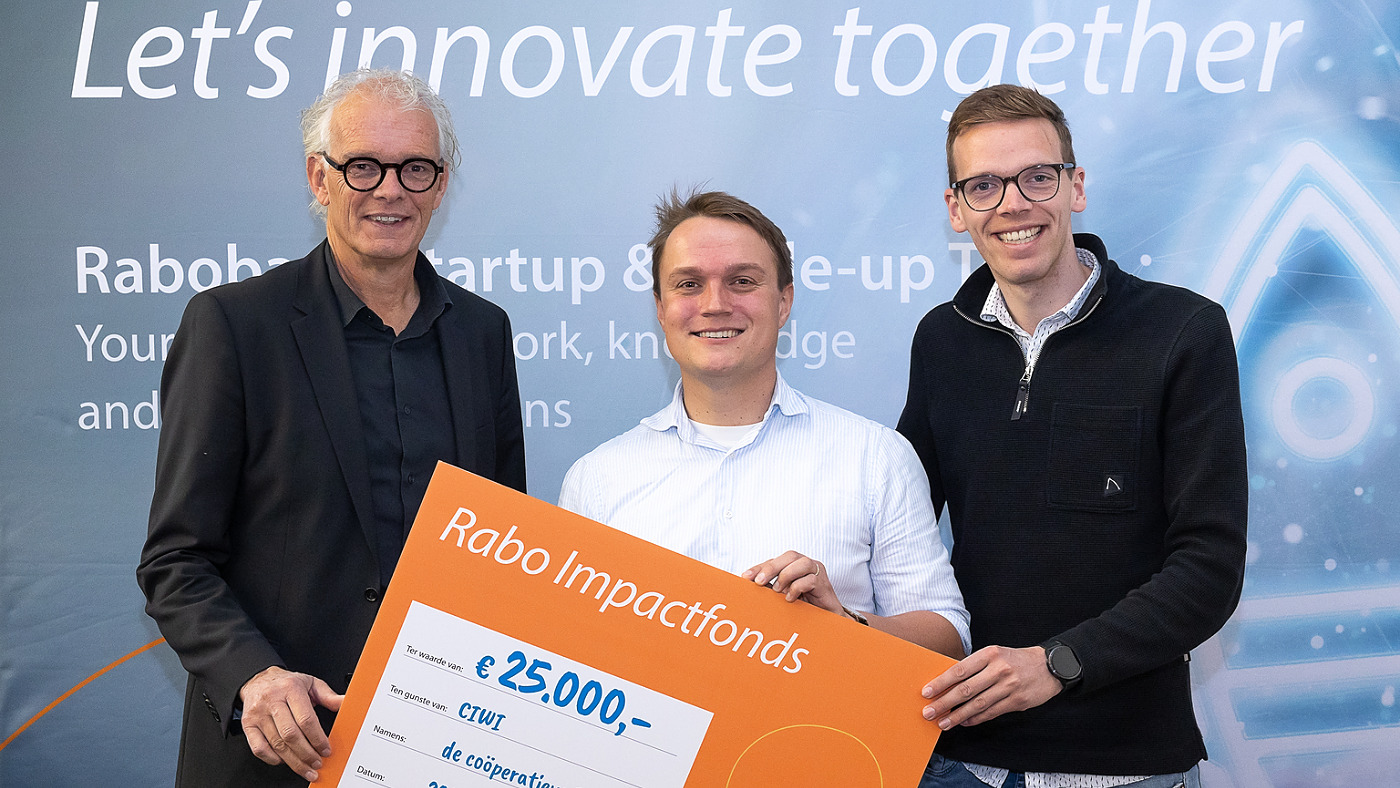
CIWI requires funding to carry out the test. “As an early-stage start-up, we’re not quite at the loans and investment stage yet. That’s when the Rabo Impact Fund came into the picture,” says Jasper. The CIWI founders are thrilled with the €25,000 donation they received. “It gives us peace of mind and allows us to focus our attention on making the tech a success,” continues Jasper. “It’s also a recognition of our work. It sends a message,” says Erik. “Start-ups have nothing to fall back on; they need to prove themselves to potential stakeholders. Being able to mention the Rabo Impact Fund as a partner opens doors for us. The support from the fund is a huge help.”
Drivers of innovation
Rick van Schie, who runs a horticultural business in Westland, sat on the Rabo Impact Fund’s advisory board at the time the donation was awarded to CIWI. “It was a unanimous decision,” he says. “Water scarcity is getting worse by the day, and it’s becoming harder to remove contaminants. That’s why supporting a fantastic innovation like CIWI was a no-brainer. Start-ups such as CIWI play a crucial role as drivers of innovation. They’re the ones upping the ante and creating ripples in the industry. The world needs more companies like this, so we’re more than happy to provide support from the Rabo Impact Fund!”